
Factory
Private Label Clothing Manufacturer: How Private Label Works and What Drives the Cost
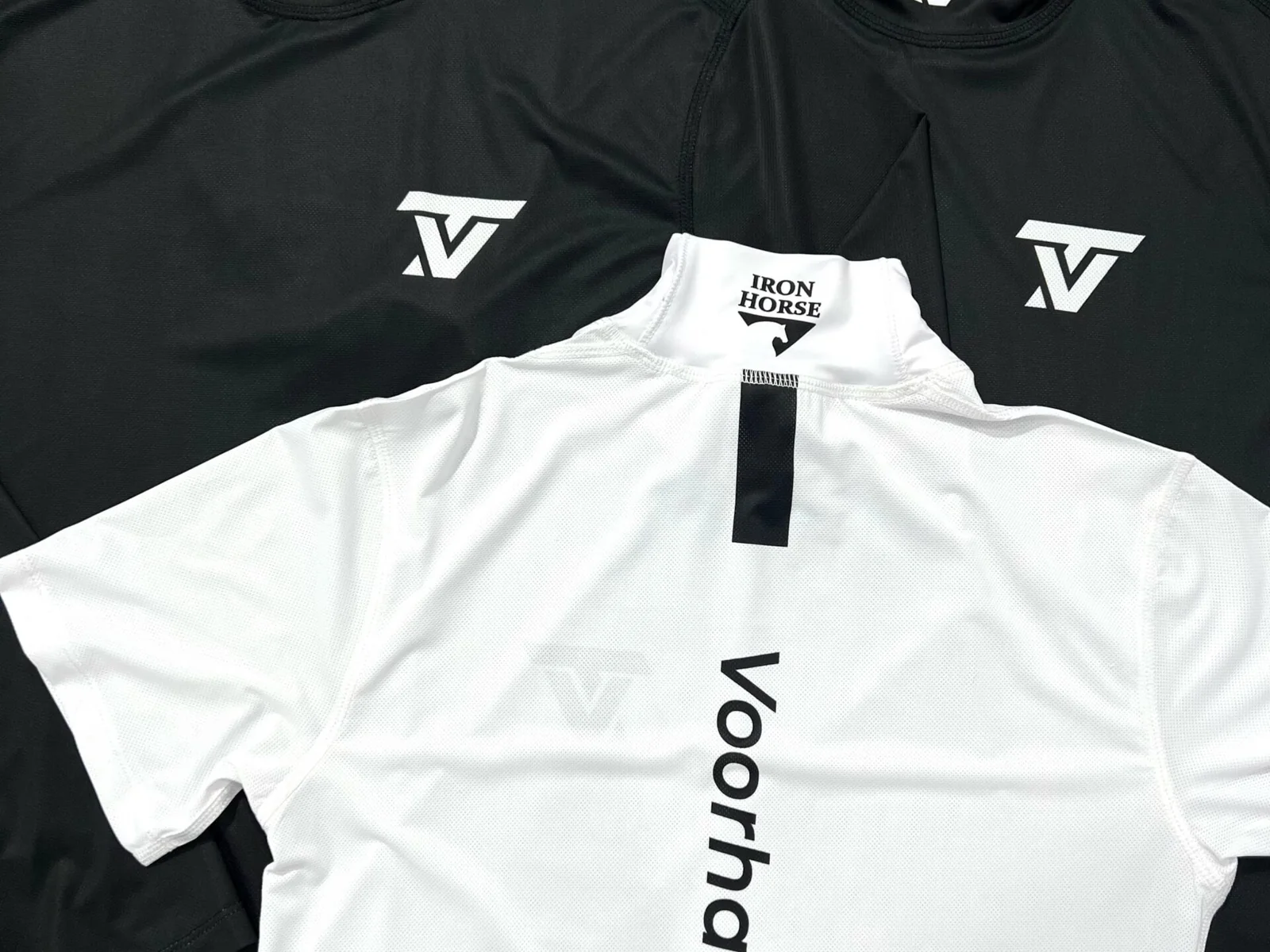
A private label clothing manufacturer makes garments that are sold under your brand, with your labels, tags and packaging. The quickest route starts from a style the factory already makes well and changes the fabric, colour, details and branding. The fullest route develops the garment from your own design. Your cost per piece is driven mainly by fabric, construction, decoration, branding and quantity. At Iron Horse there is no minimum order quantity: you can order from 1 piece per style per colour, and the price per piece comes down as volume goes up.
What a private label clothing manufacturer actually does
Private label means the garment carries your brand, not the maker’s. The manufacturer produces it, sews in your neck label and care label, attaches your hang tag, packs it the way you specify and ships it to you or your warehouse. To your customer, it is simply your product.
The trouble is that suppliers use the term loosely, and two quotes for “private label” can describe very different things. It helps to know the three arrangements people usually mean, because each carries a different level of control, cost and exclusivity.
White label
The lightest version. The supplier sells a finished stock garment and you add your branding, usually a printed logo and a swapped or added label. It is fast, but the garment underneath is the same one any other brand can buy.
Private label on an existing style
The factory starts from a pattern it already makes well, such as a hoodie, polo or t-shirt, and adapts it for you: your fabric and colour, your trims, changes to length or fit, your prints or embroidery, your labels. You skip much of the pattern development, and the result is far more yours than a white label blank.
Full package from your own design
You bring a sketch, tech pack or reference garment, and the manufacturer develops the pattern, sources the materials, makes a sample and produces the order. This is often called OEM or cut and sew production, and it gives you the most control. If you are still deciding which kind of factory you need, our guide on how to find a clothing manufacturer explains the main types and how to tell them apart.
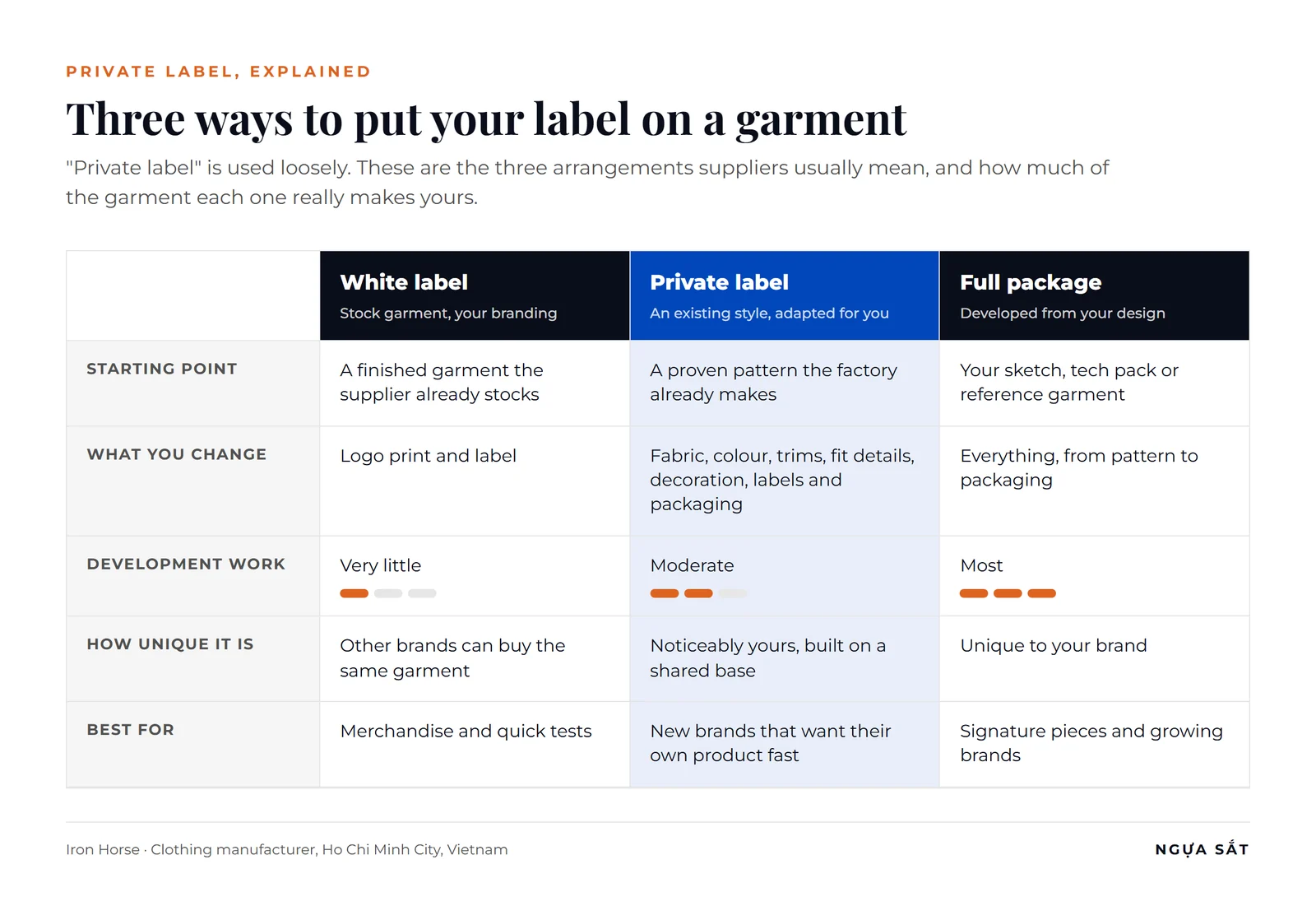
For most new brands the middle option is the sweet spot. It is quicker and less risky than developing from nothing, and you are not selling the same blank as everyone else.
What you need to bring, and what the factory can handle
You do not need a finished technical design to start a private label programme, but the clearer your brief, the more accurate your quote. At a minimum, have these ready:
- Reference: a sketch, photos, or a garment whose fit you like.
- Fabric direction: fibre, weight and feel, even roughly, such as “heavyweight cotton fleece” or “lightweight moisture-wicking knit”.
- Colours: every colourway you want, ideally with reference codes.
- Size range: which sizes, and a rough idea of how the order splits between them.
- Branding files: logo and label artwork in PSD or AI format, with the size and position you want.
- Target quantity and target price, so the factory can suggest where to spend and where to save.
If you want the garment specified properly before quoting, a tech pack is the document that does it. Our explainer on what a tech pack is covers what goes inside one, and our tech pack service can build it for you. At Iron Horse, fabric and trim sourcing, graphic design, labels and tags are all handled in-house, so a founder with a clear idea but no technical files can still get to a sample.
The branding pieces that make it private label
The label is what turns a garment into your product, and there is more to it than a logo at the neck. A complete private label programme usually includes:
- Main label: the brand label at the neck or side seam. Woven labels feel premium, while printed labels are softer against the skin and suit activewear.
- Size and care label: size, fibre content and care symbols. If you sell in the United States, federal rules require fibre content, country of origin and the identity of the business responsible, and the FTC Care Labeling Rule requires care instructions on most apparel.
- Hang tag: the swing tag carrying your branding, price or story.
- Decoration: screen printing, heat transfer, digital printing or embroidery.
- Packaging: individual poly bags and cartons as standard, or custom packaging if the unboxing matters to your brand.
Each of these is a line on your cost sheet, so decide early which ones matter for launch and which can wait for the second order.
What drives the cost per piece
There is no honest single price for a private label garment, because the cost is built from a handful of decisions you control. These are the ones that move it most.
Fabric
Usually the biggest single cost. Weight, fibre, finish and whether the fabric is a stock item or has to be dyed to your colour all matter. Performance fabrics and specialist finishes cost more than standard cotton jersey.
Construction
Every extra panel, pocket, zip or row of topstitching is another sewing operation. A basic t-shirt has few. A technical training jacket has many.
Decoration
The number of print colours, the print size, the number of placements and the embroidery stitch count all add cost. An all-over sublimated print on sportswear is priced very differently from a single chest logo.
Quantity
Setup work such as patterns, screens and embroidery files is spread across the units in the order, so more units means a lower cost per piece. At Iron Horse there is no minimum, but the price per piece adjusts with order size, so a 10-piece run costs more per unit than a larger run of the same style.
Sampling, shipping and duty
Samples carry a fee, and shipping, import duty and taxes sit on top of the factory price. Ask for the quote on a stated trade term, such as EXW, FOB or CIF, so you know exactly what is included.
A useful habit is to ask for the quote broken down by these elements. It shows you where the money goes and gives you something concrete to adjust if the total is above your target.
How a private label order runs
Whatever the garment, a private label order moves through the same stages.
- Brief and quote. You share references and quantities, and the factory confirms a sample cost and an estimated bulk price.
- Artwork and specification. Designs, label artwork and placements are finalised for your approval.
- Sampling. The sample is made to the approved specification. At Iron Horse, sample lead time is 7 to 30 days from the date all details are confirmed, we cover the courier cost of sending it to you, and the sample fee is refunded once you place a bulk order.
- Approval. You check fit, fabric and branding on the real garment. Changes to artwork, embroidery or print files after confirmation restart the sample timeline, which is why a complete brief matters.
- Bulk production. The approved sample becomes the standard, and the same specification carries straight into production.
- Packing and shipping. Garments are labelled, bagged and packed, then sent by courier or, for larger orders, by sea freight.
Our working process page shows each stage in more detail, and our sample policy sets out exactly what we need before a sample starts.
Questions to ask any private label manufacturer
- Is this garment developed for me, or is it a stock style other brands also sell?
- What is the minimum per style and per colour, and how does the price change as quantity rises?
- What does the quote include: fabric, trims, labels, packaging, decoration, shipping?
- How much is a sample, is the fee refundable, and how long does it take?
- Who owns the design files and artwork once they are made? At Iron Horse, the design packs we create become your property on delivery.
- Will bulk be made from the same fabric and specification as my approved sample?
- What are the payment terms? Ours are straightforward: orders under USD 2,000 are paid in full before production, and larger orders are a 50% deposit with the balance before shipment.
A manufacturer that answers these clearly, and in writing, is usually one you can work with.
Red flags to watch for
- A price with no specification behind it. If the quote does not state fabric weight and composition, it can change later.
- Pressure to skip the sample. A sample is the cheapest place to find a mistake.
- Vague answers about exclusivity. If you are paying for a custom product, you should know whether the same design can be sold to someone else.
- No clarity on labelling. A factory that cannot tell you what your care labels will say is leaving the compliance risk with you.
- Communication that slows down once the deposit is paid.
Starting a private label line with Iron Horse
Iron Horse manufactures in Ho Chi Minh City, Vietnam, for brands selling in the US and internationally. Private label runs can start from 1 piece per style per colour, with design, sourcing, sampling, labels, packaging and shipping handled in one place. Browse the kind of garments we make in our product catalogue, from the classic fleece hoodie to the performance compression training set, then send us your references.
Ready to put your label on it? Request a quote with your references and target quantities, or send us your design and we will come back with a sample cost and an estimated bulk price.
 Vietnamese
  English