Nhà máy
Clothing Manufacturers for Small Businesses and Startups: How to Make a First Run Without a Big Minimum
Most clothing factories set minimum order quantities because their setup costs have to be spread across enough units to be worth running. For a startup, that minimum is often the biggest barrier to launching. The way through is a manufacturer that works in small batches, combined with a focused first collection: few styles, few colours and a realistic size split. Iron Horse has no minimum order quantity, so you can order from 1 piece per style per colour. Expect a higher price per piece on very small runs, and budget for samples, production, shipping and import duty.
Why most clothing factories have minimums
A minimum order quantity, or MOQ, is not arbitrary. Before the first garment is sewn, a factory has to make the pattern, prepare print screens or embroidery files, buy fabric, often by the roll, and set up the sewing line. That work costs roughly the same whether the order is 10 pieces or 1,000. Large factories set high minimums so the setup cost disappears into the volume.
For a small business, that creates a hard choice: commit a big share of your budget to stock you have not tested, or keep looking. Plenty of founders end up with boxes of unsold sizes because the minimum, not demand, decided how much to make.
What “no MOQ” actually means
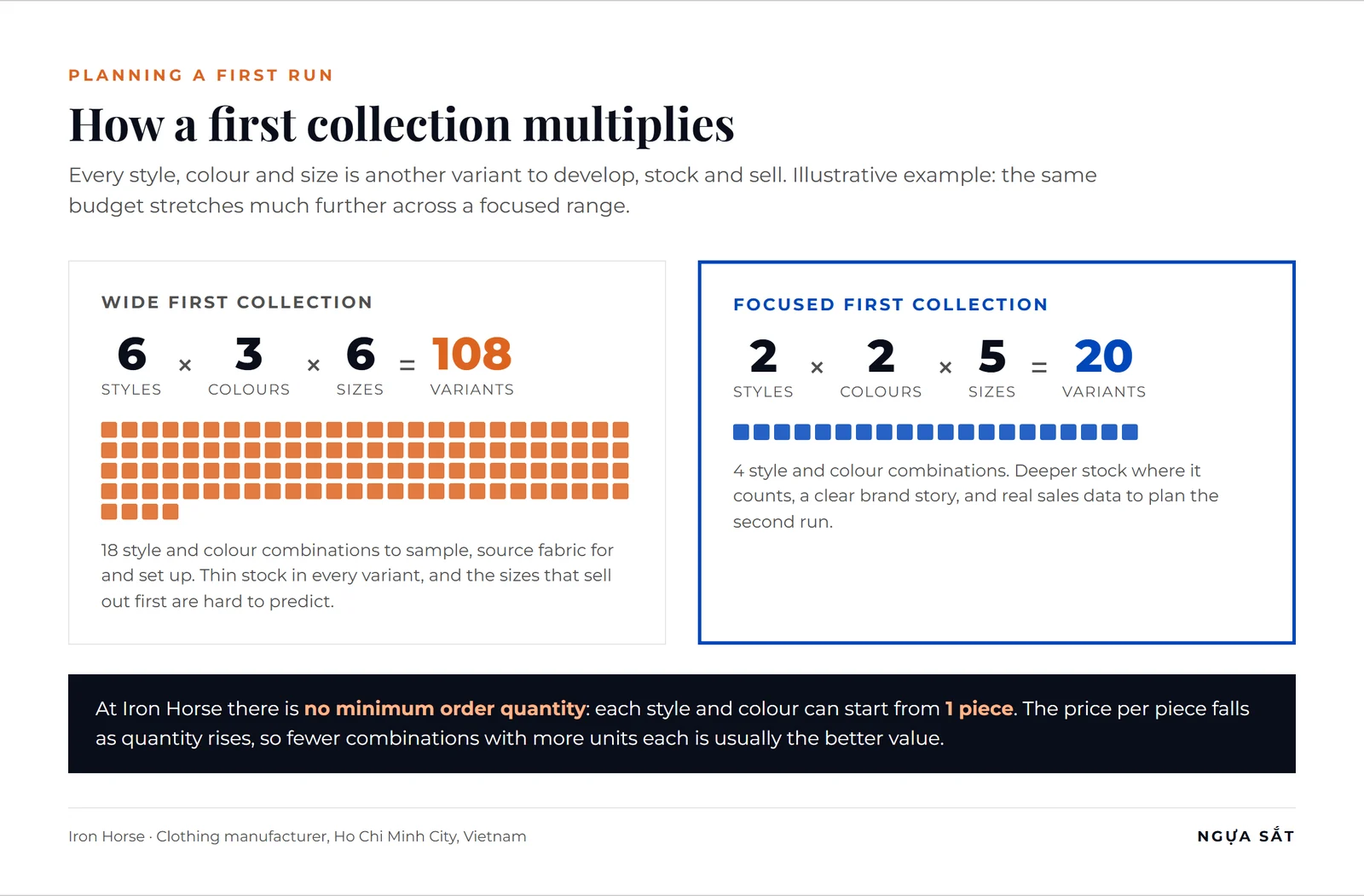
At Iron Horse there is no minimum order quantity. You can order as few as 1 piece per style per colour, whether that is a sample or a small first drop. That makes it possible to test a design with real customers before committing to volume, and to restock only the sizes that actually sell.
Two honest caveats. First, the setup work still has to be paid for, so the price per piece is higher on very small runs and falls as quantity rises. Second, the minimum is counted per style and per colour, so the way you structure a collection has a big effect on what the order costs.
Plan a first collection that fits the budget
The quickest way to overspend is a first collection that is too wide. Every extra style, colour and size multiplies the number of variants you pay to develop and hold in stock.
- Start with a small number of styles. Two or three hero pieces that define the brand beat ten pieces that dilute it.
- Limit colours. One or two colourways per style keeps fabric and thread buying simple.
- Choose a size split from your audience, not a template. If you sell to a specific community, you may know its size mix better than any standard ratio.
- Keep decoration simple on the first run. One well-placed print or embroidery is cheaper to set up than several placements.
- Reuse components. The same main label, hang tag and packaging across every style saves setup cost.
If you are not sure which garments to lead with, our danh mục sản phẩm shows the categories we make most often, from the fleece hoodie và áo thun đến cotton twill cap.
What to budget for
The factory price is only part of the cost of getting product into your customers’ hands. A realistic first budget covers each of these:
| Cost | What it covers | Worth knowing |
|---|---|---|
| Tech pack or design | Specification and artwork | Optional if you already have production files |
| Mẫu | A development sample per style | Iron Horse refunds the sample fee once a bulk order is placed |
| Sản Xuất Chuyên Nghiệp | Fabric, trims, cutting, sewing and finishing | Price per piece falls as quantity rises |
| Branding | Labels, hang tags and packaging | Reuse across styles to save setup |
| Shipping | Air or sea freight | Air around 5 to 7 days, sea 20 to 45 days |
| Duty and taxes | Import charges in your country | Check with your customs broker |
Payment terms matter for cash flow too. At Iron Horse, orders under USD 2,000 are paid in full before production. Orders over USD 2,000 are a 50% deposit before production, with the remaining 50% before shipment.
A realistic timeline for a first run
- Spec and quote. Share sketches, photos or a reference garment and receive a sample cost and an estimated bulk price. If you need a proper specification first, our dịch vụ tech pack handles it, and tech pack là gì explains what one contains.
- Sampling. 7 to 30 days from the date every detail is confirmed. Changes to artwork, embroidery or print files after confirmation reset the timeline.
- Sample approval. Check fit, fabric and branding on the physical piece, not a photo alone.
- Bulk production. Timing depends on order size and the production schedule, and is confirmed with your quote.
- Shipping. Air for speed, sea for larger orders where cost matters more than days.
Each stage is described on our quy trình sản xuất page, and the sampling rules are in our chính sách may mẫu.
Get the most out of your sample
For a small business the sample is not a formality. It is the cheapest point at which to catch a problem, and on a small run there is no volume to absorb a mistake later. A few habits make it count:
- Ask for the sample in the real production fabric and colour, not a substitute that happens to be in stock.
- Have it made in the size you expect to sell most, then try it on real people, not only a hanger.
- Wash it the way your customers will, and check shrinkage, colour and print before you approve.
- Photograph it and keep it. The approved sample becomes the reference that bulk is checked against.
At Iron Horse we send photographs of the finished sample for you to confirm before it leaves the factory, then ship it to you by courier at our cost.
When to scale beyond a test run
The point of a small first run is to learn, so decide in advance what you are watching for. Useful signals are simple: which styles sell through first, which sizes run out, and whether customers come back for a second colour. Once a style has proven itself, reorder it on the same specification and put more units behind it, because that is where the price per piece starts to work in your favour.
Keep your files in order as you go. At Iron Horse, the design packs we create become your property on delivery, so a reorder is quick and the product stays consistent however much you grow.
What to look for in a manufacturer for a small business
- Genuine small-batch capability, stated in writing as a minimum per style and per colour.
- A sample stage before bulk, with the sample fee and turnaround stated upfront.
- Clear pricing tiers, so you can see how the per-piece cost changes as you grow.
- Help with the parts you do not have in-house, such as design, tech packs, sourcing and labels.
- Room to grow. The factory that makes your 20-piece test should be able to make your reorder when it sells.
Our step-by-step guide on cách tìm xưởng may gia công quần áo covers where to look and how to compare quotes.
Red flags for startups
- A “low MOQ” that turns out to apply only to stock blanks.
- A small-run price that is not in writing.
- No sample, or a sample made in a different fabric from the bulk order.
- Pressure to add styles or colours to make the order “worthwhile”.
- Slow or vague communication before you have paid. It rarely improves afterwards.
Start small with Iron Horse
Iron Horse makes apparel in Ho Chi Minh City, Vietnam, for startups testing new designs without high upfront inventory costs, and for established brands that need small batch runs or samples. There is no minimum order, and a free consultation covers production, costs, lead times and delivery, so you know what your first run will involve before you commit.
Ready to plan your first run? Gửi yêu cầu báo giá with your designs and quantities, or get in touch and we will help you shape a first collection that fits your budget.
 Vietnamese
  English